The MARÉIRE report identifies persistent and material scientific uncertainty in relation to offshore renewable energy impacts on protected habitats and species in Irish waters, including seabed integrity, prey-mediated effects on birds and marine mammals, ecosystem functioning, and cumulative and in-combination impacts.
In particular, the report highlights significant evidence gaps regarding the behavioural, physiological, and population-level consequences of construction and operational underwater noise for Annex II and IV marine mammals, as well as emerging indications of effects on fish and invertebrates that underpin protected species’ food webs. Under Article 6(3) of the Habitats Directive, such uncertainty cannot be resolved in favour of development: where the absence of adverse effects on the integrity of Natura 2000 sites cannot be established beyond reasonable scientific doubt, the precautionary principle requires refusal or deferral of consent rather than reliance on post-consent monitoring, adaptive management, or future research.
The report therefore exposes a fundamental tension between the current trajectory of offshore wind consenting and the legal obligation to apply precaution where knowledge gaps coincide with protected species and legally protected ecosystem functions.
This tension is not abstract: it is illustrated clearly in the extensive Requests for Further Information issued for ‘Phase 1’ windfarm proposals currently having applied for planning. The unresolved uncertainty in relation to underwater noise impacts on marine mammals, cumulative effects, prey dynamics, and ecosystem functioning etc. highlight the limitation of assessment in resolving fundamental scientific uncertainty surrounding offshore wind development now being pursued.
Read the report here.
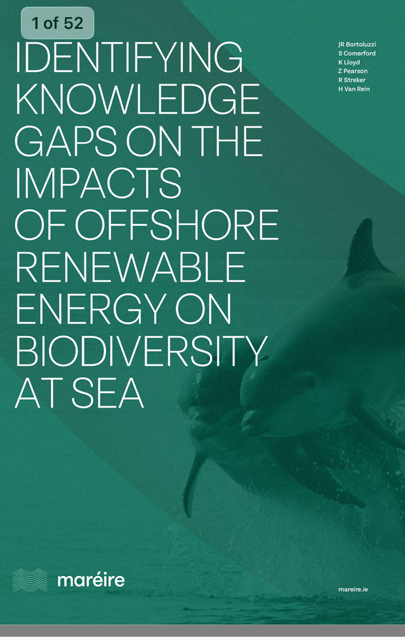
Identifying knowledge gaps on the impacts of offshore renewable energy on biodiversity at sea.
The MARÉIRE report identifies persistent and material scientific uncertainty in […]
Published on
February 3, 2026

Blue Ireland Coalition | Company Limited By Guarantee
Company Number: 755205 | Registered Office: Garadice House, 3-4 Fairview, Dublin 3, Ireland
© 2026 Blue Ireland • All Rights Reserved